
MINDSPACE can be seen as a checklist or
MINDSPACE can be seen as a checklist or principles of influences when designing for behavior.
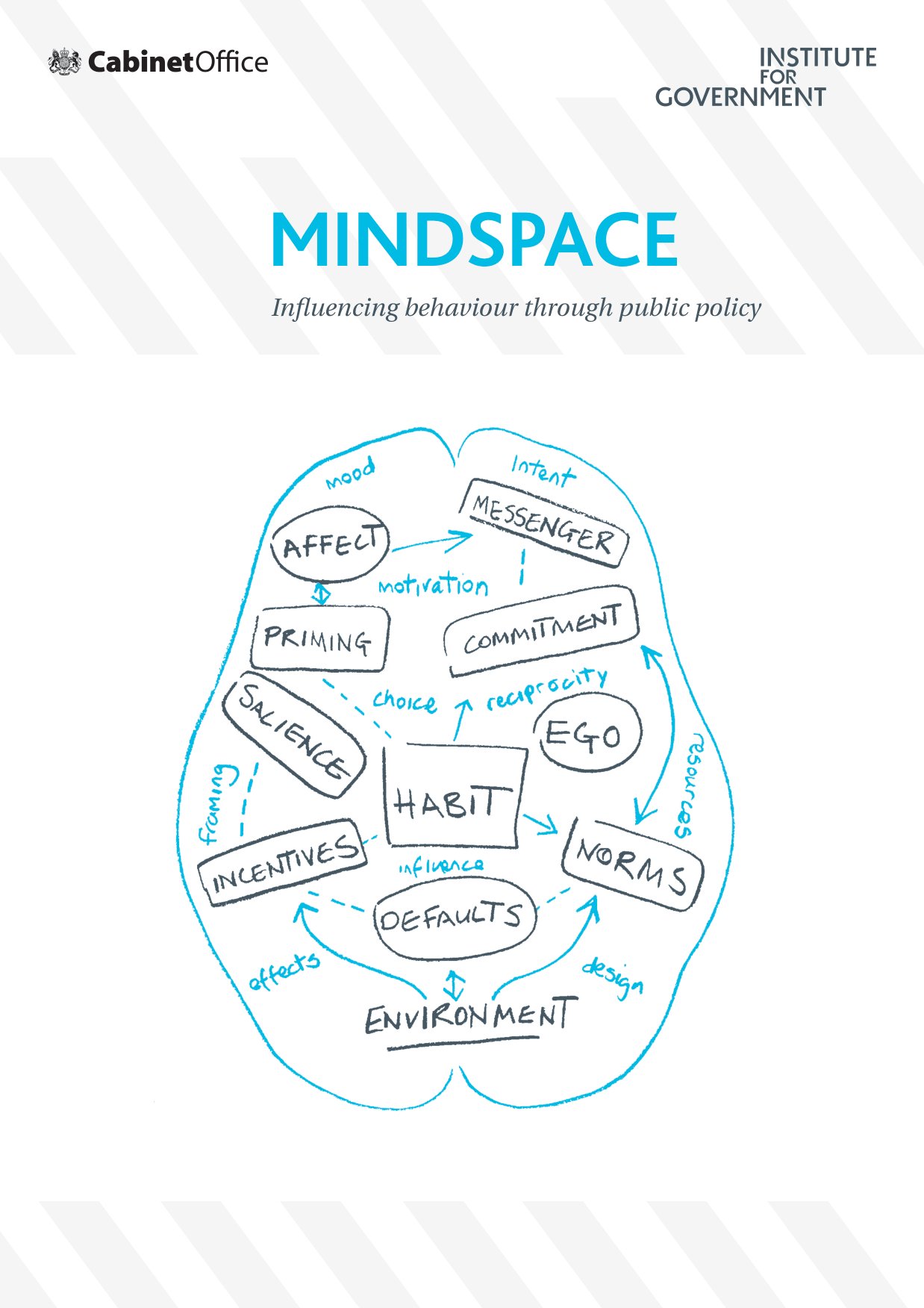
MINDSPACE can be seen as a checklist or principles of influences when designing for behavior.
MINDSPACE could also be seen as a way to integrate #behavioralscience into current processes.
it is developed by the Cabinet Office back in 2010 and it lead to the creation of the Behavioural Insights Team, and some authors like Michael Hallsworth were part of creating it.
Its acronym is comprised of
Messenger We are heavily influenced by who is communicating information.
Incentives Our responses to incentives are shaped by predictable mental shortcuts, such as the strong desire to avoid losses.
Norms We are heavily influenced by what others do.
Defaults We “go with the flow” of pre-set options.
Salience Our attention is drawn to novel things that seem relevant to us.
Priming (this one has had some recent controversy) Our actions are often influenced by subconscious cues.
Affect Our actions can be powerfully shaped by our emotional associations.
Commitments We seek to be consistent with our public promises and to reciprocate actions.
Ego We act in ways that make us feel better about ourselves.
Have a look at the guide, and let me know if you have used it, or currently still use it, and if you have modified it in any way, or moved to the EAST framework instead.
MINDSPACE can be seen as a checklist or principles of influences when designing for behavior.
Sources named in this post
- SHIFT Barrier Codes..Aim For Behavior
- Jill Cane and colleagues, Theoretical Domains Framework (TDF) (2012)
- Susan Michie at UCL, BCTTv1 (Behaviour Change Technique Taxonomy v1) (2013)