
Self-paced course for change practitioners
Course status: Launching soon
From Change Plan to Behavior Change
Move from a change plan to a behavior you can specify, diagnose, and support.
Work through one change initiative from the sponsor’s starting claim to a specified behavior, the conditions around it, and an adoption plan you can test.
A rollout can be complete while the work stays the same. This course starts with the sponsor’s claim, then examines what people actually do before it moves into diagnosis or design.
Built around one worked case and tools for your own initiative.
- One workflow
- From framing to measurement
- One worked case
- Meridian Bank
- Self-paced
- Lessons and applied work
The problem
A rollout tells you what was delivered. It does not tell you what changed in the work.
Training can be complete and the project plan can be green while people still rely on the old sequence, workaround, or source of evidence. Before adding another activity, you need a behavior precise enough to examine.
The brief starts too broad.
“Adoption is low” names an outcome, not the actor, action, situation, or competing behavior.
The first explanation becomes the answer.
Resistance, training, culture, and leadership are treated as causes before the work has been examined.
The intervention arrives early.
Communication, training, or system changes are chosen before anyone has tested which condition is shaping the behavior.
Measurement follows the rollout.
Activity and sentiment are tracked while the target behavior and its context remain unclear.
What you will build
Build the case for what should change next.
You will move from the starting claim to a provisional behavior frame, a precise behavior specification, the actor system and conditions around it, and a plan for intervention and measurement. Each step produces part of a short Adoption Conditions Brief.
Adoption Conditions Brief
A concise record of the target behavior, the evidence and uncertainty around it, the conditions worth changing, and the indicators you will use to judge what happens next.
- Separate the requested change, expected result, and observable behavior
- Specify the actor, behavior, and context without hiding uncertainty
- Map the people and operating conditions around the behavior
- Diagnose before selecting an intervention
- Translate leadership and culture into observable conditions and actions
- Define behavior measures alongside implementation measures
- Change initiative
- What change are you briefing?
- Business outcome
- What outcome should improve later?
- Target behavior
- Actor + action + context + quality marker.
- Current behavior
- What do they do today instead?
- Actor system
- Who shapes whether the behavior happens?
- Diagnosis
- What is the strongest current explanation?
- Leadership and culture
- What sponsor, manager, and culture signals should change?
- Adoption conditions design
- Which binding conditions should change around the work?
- Measurement and sustainment
- What will be measured, and what happens when the signal turns amber?
- Recommended next move
- What decision, operating move, or evidence is needed next?
Look inside the brief
Preview three pages from the final Adoption Conditions Brief: its ten-section structure, the blank measurement page, and that page completed in the Meridian illustrative composite.
 View full-size page
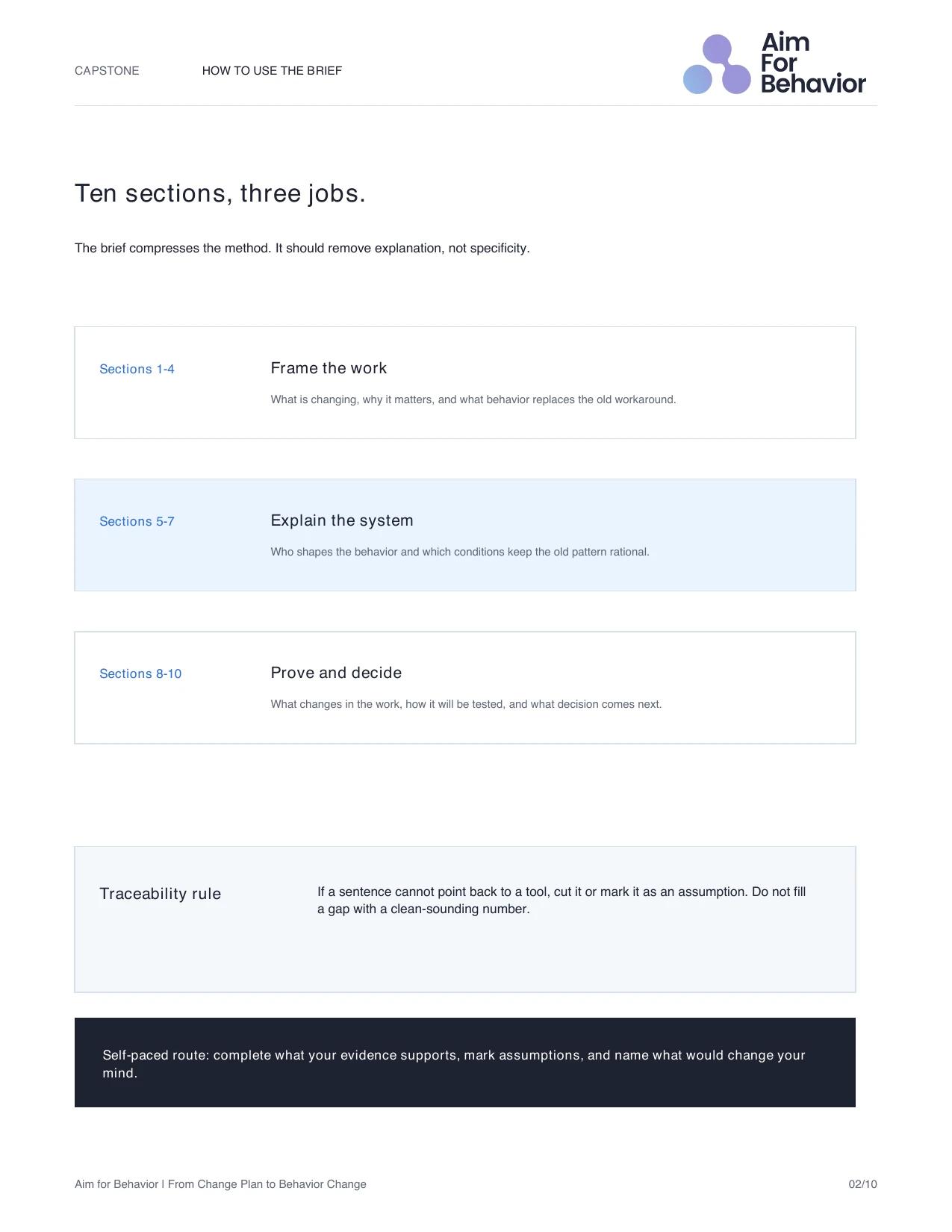
How ten sections become three jobs
This page groups the ten sections into three jobs: frame the work, explain the system, and prove and decide.
 View full-size page
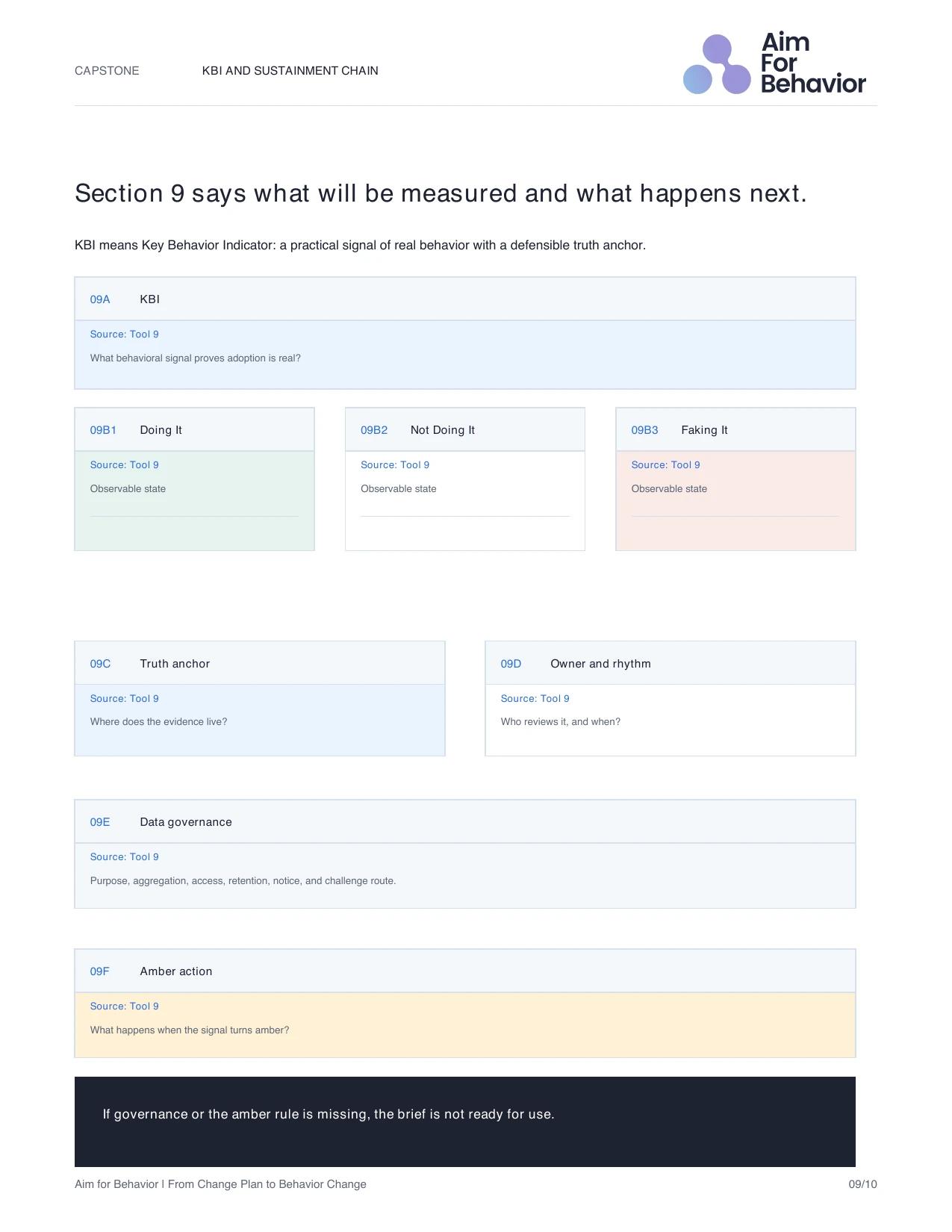
The blank measurement and sustainment page
The blank page shows the fields learners complete for the behavior indicator, observable states, truth anchor, ownership, governance, and amber action.
 View full-size page
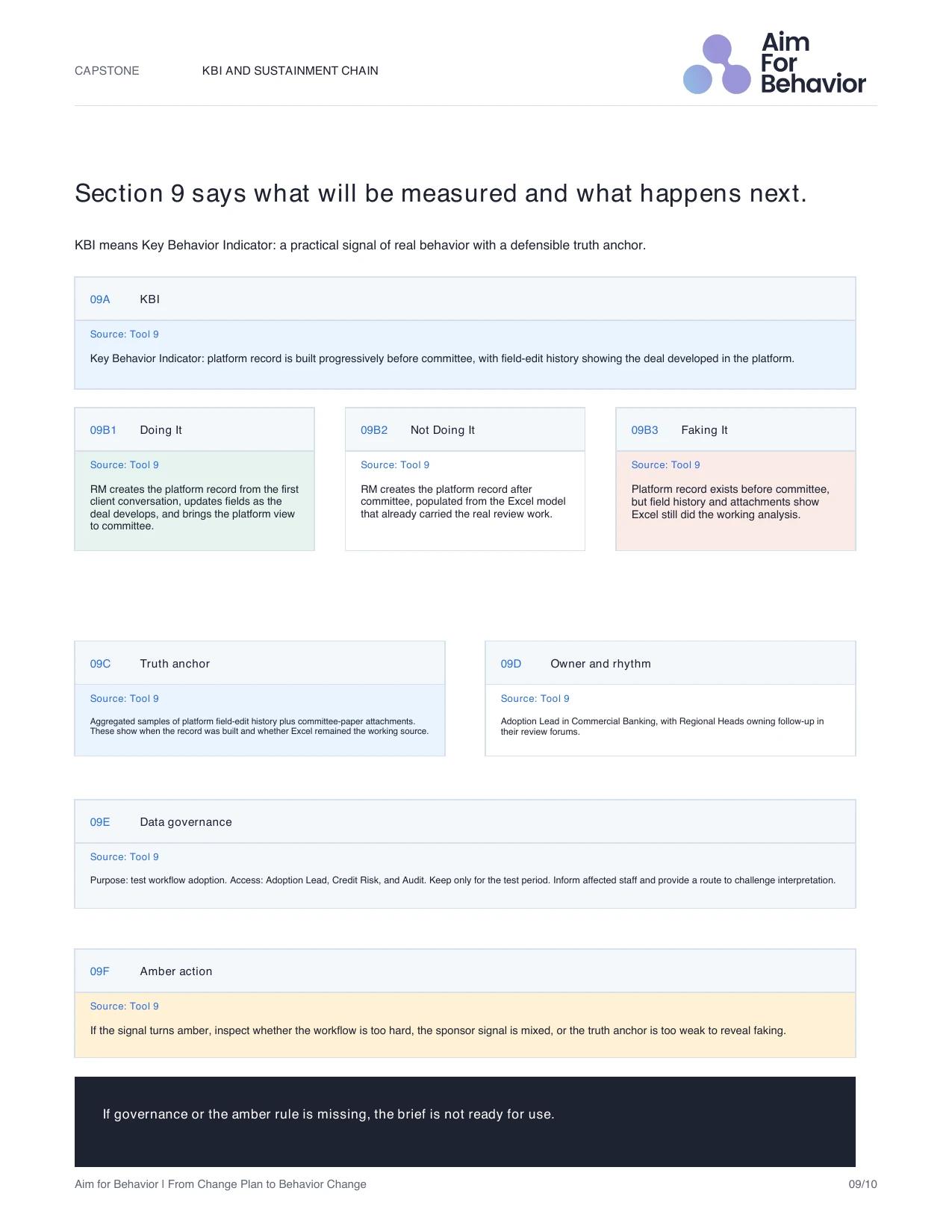
The same page completed in the Meridian illustrative composite
The Meridian illustrative composite shows a completed measurement page with evidence-linked entries, explicit governance, and a restrained amber action.
You leave with your own brief, built from the tools and evidence in your initiative.
What you will learn
Follow the reasoning from brief to measurement.
The modules form one connected course of work. An answer stays provisional until the evidence supports it, and each tool prepares the decision that follows.
- Intro
Course orientation
How does the course move from a change brief to an adoption decision? - M1
Frame the change
What are they asking to change, and what actually happens now? - M2
Specify the behavior
Who needs to do what, and in what situation? - M3
Map actors and stakeholders
Who performs, shapes, enables, or constrains the behavior? - M4
Diagnose readiness and barriers
Which conditions are helping or preventing the behavior? - M5a
Activate leadership
What must sponsors and managers do differently around the target behavior? - M5b
Examine culture and norms
Which signals make the current pattern expected, safe, or legitimate? - M6
Design adoption conditions
What response follows from the diagnosis? - M7
Measure and sustain
Did the behavior move, and what should happen next? - Capstone
Assemble the brief
What is the strongest case you can make from the evidence?
What is included
Short teaching units
Each unit teaches one decision in the workflow and shows where it hands off to the next.
A worked organizational case
Meridian Bank carries the reasoning across modules without pretending the first explanation is settled.
Tools for your own initiative
Use the blank canvases after you have seen the same reasoning worked through on the case.
A practical capstone
Assemble the outputs into an Adoption Conditions Brief for a sponsor, project team, or client.
The toolkit
Use the tools as a chain of decisions.
Each tool receives a defined output from the previous step. The worked Meridian example shows the reasoning; the blank version is for your own initiative.
- Tool 1
Change Framing Canvas
Opens the situation before selecting a provisional actor and action to carry forward.
- Tool 2
ABC Behavior Specification Canvas
Makes Actor, Behavior, and Context explicit while preserving open scope.
- Tool 3
Stakeholder / Actor System Map
Maps who performs, shapes, enables, or constrains the specified behavior.
- Tool 4
Readiness & Barrier Diagnostic
Compares conditions that may be helping or preventing the behavior.
- Tool 5
Sponsor Behavior Contract
Turns sponsorship into named actions and decisions.
- Tool 6
Manager Activation Sheet
Examines what managers need to do in the setting where adoption happens.
- Tool 7
Culture & Norms Scan
Surfaces the signals that make the current pattern expected, safe, or legitimate.
- Tool 8
Adoption Conditions Map
Connects the working diagnosis to an intervention logic.
- Tool 9
KBI & Sustainment Chain
Links behavior, implementation, context, and the decision to adapt.
- Tool Bonus
Stakeholder Engagement tool
Prepares a difficult stakeholder conversation with an opening, engagement strategy, boundary, and success indicator.
- Tool Capstone
Adoption Conditions Brief
Assembles the course outputs into a concise decision record.
The method underneath
The course workflow and SHIFT do different jobs.
The course workflow shows the practical sequence a learner follows. SHIFT is the underlying method for specifying behavior, forming and testing hypotheses, designing an intervention, facilitating implementation, and learning from the result.
The five SHIFT stages organize the reasoning underneath the course.
- Specify
- Hypothesize
- Intervene
- Facilitate
- Test
- Frame the change
- Specify the behavior
- Map the actor system
- Diagnose conditions
- Examine leadership and culture
- Design adoption conditions
- Measure and adapt
The workflow is learner-facing. SHIFT is the methodology underneath it.
Why conditions, not pressure
Behavior changes when the conditions around it change
Change the system default
At Penn Medicine, changing the EHR prescribing default from opt-in to opt-out increased generic prescribing from 75.4% to 98.4%. The 98.4% rate held across 30 months and 2,599,045 post-change prescriptions.
Olshan, Rareshide & Patel (2019), Journal of General Internal Medicine; quasi-experimental health-system study.Make the desired action automatic
At a large US corporation, automatic 401(k) enrollment increased participation among employees in tenure months 3-15 from 37% to 86%. Many employees also stayed with the default contribution rate and fund, showing why defaults must be designed carefully.
Madrian & Shea (2001), Quarterly Journal of Economics; administrative employer comparison.Build accountability into the workflow
Across 47 primary care practices, accountable justification reduced inappropriate antibiotic prescribing by 7.0 percentage points and peer comparison by 5.2 points relative to control trends. Suggested alternatives alone did not significantly change the trajectory (P = .66).
Meeker et al. (2016), JAMA; cluster-randomized clinical trial.
These studies show how defaults, workflow design, and accountability changed behavior in specific organizational settings. They are not tactics to copy unchanged or promises of course outcomes. The EHR result came from a single-system quasi-experimental study; Madrian and Shea also found default anchoring; Meeker studied prescribing in US primary care.
Who it is for
For practitioners responsible for adoption in real work
The course is for people who already have a change initiative, process, system, or service in view and need a more precise way to examine what is happening around it.
- Change and transformation practitioners
- HR, People, and OD teams
- Learning and capability leads
- Internal consultants
- Product, process, and technology adoption leads
- Program managers responsible for benefits realization
It is not designed as: a general survey of organizational behavior or a change-management certification. The work centers on specifying, diagnosing, and supporting behavior in context.
The worked case
One case, carried forward without premature closure
Meridian Bank is introducing a commercial lending platform, while important parts of deal preparation still move through spreadsheets, email, committee discussion, and later record updates. You use the case evidence to frame the situation, specify a behavior, and keep unresolved scope visible.

Full syllabus
Every unit, in order
- Intro
Course orientation
How does the course move from a change brief to an adoption decision?Meet the case, the evidence rules, and the relationship between the course workflow and SHIFT.
- Core teaching
- Short lesson
- You produce:
- A case to carry through the course
- M1
Frame the change
What are they asking to change, and what actually happens now?Treat the brief as a claim to examine. Keep the change, expected result, current pattern, evidence, alternatives, and provisional actor-action focus distinct.
- Core teaching
- Lesson + applied work
- Tool used:
- Change Framing Canvas
- You produce:
- A provisional behavior frame
- M2
Specify the behavior
Who needs to do what, and in what situation?Make Actor, Behavior, and Context explicit. Add trigger, frequency, or quality only when the extra precision changes what counts as the behavior.
- Core teaching
- Lesson + applied work
- Tool used:
- ABC Behavior Specification Canvas
- You produce:
- A precise or explicitly provisional behavior specification
- M3
Map actors and stakeholders
Who performs, shapes, enables, or constrains the behavior?Map the actor system around the selected behavior before treating every stakeholder as the same.
- Core teaching
- Lesson + applied work
- Tool used:
- Stakeholder / Actor System Map
- You produce:
- An actor and stakeholder map
- M4
Diagnose readiness and barriers
Which conditions are helping or preventing the behavior?Use behavioral and organizational evidence to compare explanations before choosing a response.
- Core teaching
- Lesson + applied work
- Tool used:
- Readiness & Barrier Diagnostic
- You produce:
- A ranked working diagnosis
- M5a
Activate leadership
What must sponsors and managers do differently around the target behavior?Translate broad calls for leadership support into named sponsor commitments and manager routines that can be observed and reviewed.
- Core teaching
- Lesson + applied work
- Tool used:
- Sponsor Behavior Contract + Manager Activation Sheet
- You produce:
- Sponsor commitments and manager routines
- M5b
Examine culture and norms
Which signals make the current pattern expected, safe, or legitimate?Examine what the setting rewards, tolerates, repeats, and makes risky before treating culture as a single cause.
- Core teaching
- Lesson + applied work
- Tool used:
- Culture & Norms Scan
- You produce:
- Cultural and normative conditions to address
- M6
Design adoption conditions
What response follows from the diagnosis?Choose and combine changes to the work, environment, support, and expectations that address the diagnosed conditions.
- Core teaching
- Lesson + applied work
- Tool used:
- Adoption Conditions Map
- You produce:
- An intervention logic
- M7
Measure and sustain
Did the behavior move, and what should happen next?Track the behavior, implementation, and context so the response can be continued, changed, stopped, or reopened.
- Core teaching
- Lesson + applied work
- Tool used:
- KBI & Sustainment Chain
- You produce:
- A measurement and adaptation plan
- Capstone
Assemble the brief
What is the strongest case you can make from the evidence?Bring the course outputs together without presenting open questions as settled findings.
- Core teaching
- Applied work
- Tool used:
- Adoption Conditions Brief
- You produce:
- A sponsor-ready brief

Who is behind this
Course author
Robert Meza
Founder, Aim For Behavior
Robert Meza works with organizations on behavioral diagnosis and change. This course turns that diagnosis-before-design practice into a sequence practitioners can apply to one initiative of their own.
The course begins with the change brief, but it does not treat the brief as the diagnosis.Connect on LinkedIn
Questions, answered
Who is this course for?
It is for practitioners working on organizational change, transformation, adoption, implementation, or capability building who have a live initiative they can examine.
What will I work on?
You will use the Meridian Bank teaching case first, then apply the same tools to an initiative of your own. The final output is an Adoption Conditions Brief.
How practical is the course?
Each module makes one decision in the workflow and pairs it with a canvas, diagnostic, map, or brief. The behavioral science sits underneath the work rather than replacing it.
How does SHIFT relate to the seven-step workflow?
The seven steps show the learner journey through the course. SHIFT is the five-stage methodology used to specify behavior, compare explanations, design a response, support implementation, and learn from results.
Can a team take it together?
Team and organizational options are planned. Join the waitlist for the individual launch or contact Aim For Behavior to discuss a team use case.
When does enrollment open?
The course is still in development. The waitlist will receive the launch date, price, and access details when they are confirmed.
What you will build
Bring one change initiative. Work out what the evidence supports.
Join the waitlist to receive the launch date, price, and access details when enrollment is ready.
Join the waitlist