Online course for product, service, and content teams
Course status: Available
Behavior Design
Design for the behavior people need to carry out.
Learn a practical process for turning behavioral evidence into product features, content, services, communications, and experiences people can use and follow through on.
A feature can ship and a service can launch without changing what people do. The course shows how to define the behavior, examine the evidence, select a strategy, and translate it into a design you can test.
Online course · four modules · four worked case studies.
- 4 modules
- Understand, Define, Drive, Design
- 4 cases
- Worked applications
- Online
- Course platform
The problem
A launched design is not the same as a changed behavior.
People can understand a product, service, or message and still not carry out the intended action. The useful question is not how to make the design more persuasive in general, but what is shaping the behavior in that setting.
The outcome is mistaken for the behavior.
Engagement, retention, and conversion are measures. They do not yet name what a person needs to do.
The solution arrives before the diagnosis.
A nudge, reward, reminder, or content change is selected before the barrier has been examined.
The science stays separate from the design.
A framework can describe the problem without showing what should change in the feature, service, content, or journey.
What you will build
Move from a broad problem to a design you can test.
The course follows four connected moves: understand the problem and evidence, define the behavior and context, select a strategy, and translate it into a design.
A behavior-informed design direction
A documented path from the behavior and evidence to an intervention strategy and a design idea ready for prototyping.
- Define a behavioral problem without collapsing it into a business metric
- Map and select the behavior that matters for the design
- Use COM-B and contextual evidence to examine what shapes the behavior
- Compare intervention strategies and behavior change techniques
- Translate a strategy into features, content, services, or communications
- Make the reasoning visible enough to review and test
- Challenge
- Drivers (COM-B)
- Solution / Intervention
- Target Behavior
- Outcome
What you will learn
Four modules, each ending in a design decision
The sequence keeps problem definition, behavior selection, intervention strategy, and design translation distinct.
- 01
Understand
What is the problem, and what does the evidence show? - 02
Define
Which behavior, for whom, and in what context? - 03
Drive
Which intervention strategy fits the diagnosis? - 04
Design
How does the strategy become something people encounter?
What is included
Step-by-step lessons
Work through the same sequence from problem definition to design, with examples at each stage.
Four case studies
See the method applied in different product, service, and organizational contexts.
Worksheets and templates
Use the course materials to record the evidence, behavior, intervention logic, and design direction.
Completion certificate
Complete the course and receive a Behavior Design certificate.
The method underneath
Behavioral science, used as design reasoning
The course uses COM-B, the Behavior Change Wheel, and behavior change techniques inside a practical design sequence. The frameworks help organize evidence and options; they do not choose the design for you.
- Understand the problem and evidence
- Define the target behavior and context
- Select an intervention strategy
- Translate the strategy into a design
Each move leaves a decision record that the next move can use.
Who it is for
For people who design what others use
The course is intended for practitioners who shape products, services, content, communications, or customer and employee experiences.
- Product managers and designers
- UX and service designers
- Content and communications teams
- Marketing practitioners
- Innovation teams
- Researchers working with design teams
It is not: a catalogue of nudges or a promise that one framework will explain every behavior. You will be expected to work with evidence and make design choices.
Full syllabus
Every unit, in order
- 01
Understand
What is the problem, and what does the evidence show?Define the problem, work with available data, triangulate evidence, and look for patterns before selecting a behavior.
- 02
Define
Which behavior, for whom, and in what context?Map possible behaviors, select the target, and make the relevant context explicit.
- 03
Drive
Which intervention strategy fits the diagnosis?Compare intervention functions and behavior change techniques against what is shaping the behavior.
- 04
Design
How does the strategy become something people encounter?Translate the intervention logic into product features, content, services, communications, experiences, and prototypes.

Who is behind this
Course author
Robert Meza
Founder, Aim For Behavior
Robert Meza is a behavioral strategist who works with teams on diagnosis, intervention design, and implementation. He built Behavior Design to make that reasoning usable inside ordinary product, service, content, and innovation work.
A framework becomes useful when it changes the question the design team asks next.Connect on LinkedIn
What is included
Format and access
Individual access
€297Online course · four case studies · worksheets and templates
Buy the course · €297Organization access
Let us talkTeam or organisation licensing available
Book a call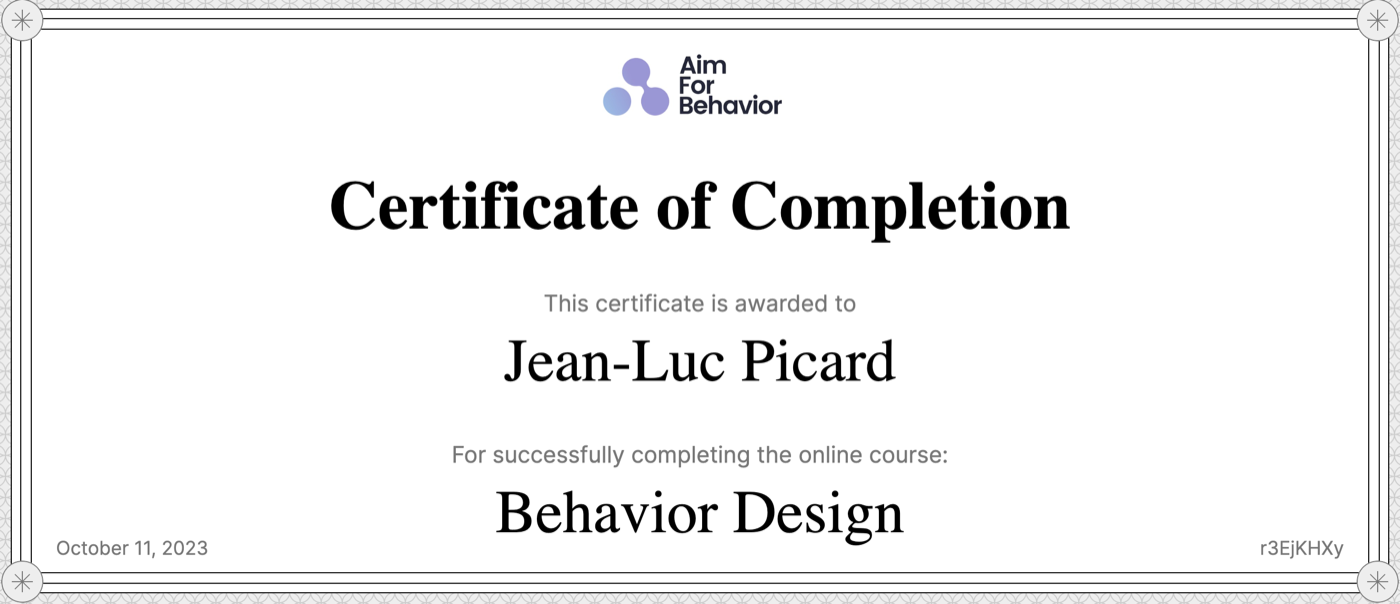
Behavior Design certificate
Complete the course to receive a certificate you can add to your professional profile.
Questions, answered
Who is the course for?
It is for people designing products, services, content, communications, or experiences who need to connect behavioral evidence to practical design decisions.
Where is the course delivered?
Enrollment and lessons are provided through the Aim For Behavior course platform.
What will I work with?
The course includes step-by-step lessons, four case studies, and downloadable worksheets and templates for the four-part process.
Will I receive a certificate?
Yes. A completion certificate is included.
What is the refund policy?
The course platform offers a 14-day guarantee, provided you have not already completed a substantial part of the course. Check the purchase page for the current terms before buying.
What you will build
Turn the evidence into a design direction.
Work through the four decisions, then leave with a direction you can prototype and test in the product, service, content, or journey.
Buy the course · €297